This interview is part of a 2024 study on how professionals use AI at work. Names are changed; the transcript was edited for clarity with the help of AI. The study is now closed. About the study →
Interviewer: In today’s interview, we are speaking with Nicoletta, a copywriter and strategic communication consultant. Nicoletta, can you tell us specifically what you do?
Nicoletta: Hi everyone! Sure, I mainly focus on copywriting and communication consulting. In recent years, I’ve specialized in brand identity design and communication strategies. In addition to writing content, I plan and create annual or semi-annual communication plans, with a cross-channel approach that includes videos, graphics, and text content. I collaborate with professionals, small businesses, and public administrations, offering customized solutions and strategies suited to each need.
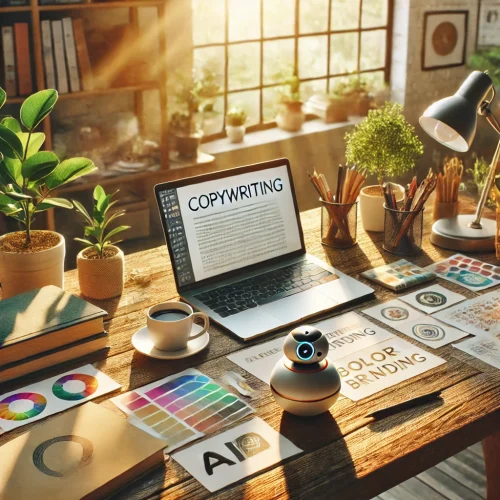
AI as a support to overcome the initial block of a copywriter
Interviewer: Nicoletta, how do you use artificial intelligence in your daily work?
Nicoletta: My use of AI is limited but useful in certain contexts. For example, I use tools like ChatGPT to create an outline or an initial structure when I need to start a complex project. This helps me overcome the initial block and provides a foundation to build upon. However, the final content always requires strong personalization and human intervention.
Interviewer: What other AI tools have you tried?
Nicoletta: I’ve used Canva with AI features for the graphic part and Microsoft’s Copilot for writing. However, the results have been mixed. For complex communication projects, AI struggles to grasp the strategic and creative nuances needed, especially to personalize the tone of voice or the language required by clients.
The impact of AI on communication projects
Interviewer: Have you noticed significant differences in using AI for communication projects compared to other activities?
Nicoletta: Yes, in communication projects, AI is less effective when it comes to adapting to specific contexts such as city branding or designing complex strategies. While it can be useful for preliminary or simple tasks, the final result always depends on human intervention. For example, when I tried to use it to develop content suitable for multiple channels, I found it difficult to create truly personalized content.
What are the advantages and limitations of artificial intelligence?
Interviewer: So, what limitations have you found in using AI?
Nicoletta: The main limitations are twofold. On one hand, AI often uses banal and stereotypical language, which is not suitable for tailor-made projects like I mentioned earlier. On the other hand, it tends to provide inaccurate or outdated information, especially when available sources aren’t updated. This forces me to manually verify every piece of data and, in some cases, rewrite entire sections.
Interviewer: Can you provide a specific example of a problem related to the reliability of sources?
Nicoletta: Certainly. An emblematic case was a communication project where I asked AI to provide up-to-date data on an ever-evolving sector, specifically the renewable energy market. Despite explicit requests to use recent sources, the AI provided outdated and, in some cases, even incorrect information. For instance, it cited 2018 statistics when the project required data updated to 20231.
Interviewer: What advantages does AI offer you in your work?
Nicoletta: AI has been useful for organizing ideas and speeding up the early stages of a project, like brainstorming or initial analysis. In some cases, it has suggested ideas I hadn’t considered. It’s a practical tool for repetitive tasks, but it can’t replace the creativity and empathy I bring to my projects. Its value lies in saving time by providing a starting point.
Automating repetitive tasks with AI
Interviewer: What part of your work would you like to automate with AI?
Nicoletta: The administrative part. Managing invoices, analyzing data, and creating reports are tasks I find boring and unstimulating. Automating them would allow me to focus more on creativity and strategy, which are at the heart of my work. Additionally, I think AI could be useful for tracking the progress of a project and providing more detailed analyses of results.
Unique challenges in collaborating with public entities
Interviewer: What difficulties have you encountered working with public administration and AI?
Nicoletta: The public administration is a world of its own. Often, due to internal policies, they use tools that don’t communicate with external platforms. This makes collaboration with external consultants more complicated, limiting the possibility of integrating AI to improve processes. For example, even setting up a meeting can become a difficult task. AI could have great potential to simplify these interactions, but at the moment I don’t see implementable solutions in this sector.
Case study: city branding
Interviewer: Have you used AI for complex projects like the city branding you mentioned earlier?
Nicoletta: Yes, for a municipality in Italy, I developed a brand identity project. I defined the tone of voice, communication channels, and a cross-channel plan on an annual basis. However, AI was not helpful for the strategic or creative nuances, which always require human intervention. The language of AI is too standardized for these projects, and the specific requests from the client require a high level of adaptation.
How to educate clients about AI usage
Interviewer: What is your clients’ reaction when you propose AI tools?
Nicoletta: Many clients are either unfamiliar with AI or perceive it as a “cold” tool that could compromise the quality of work. One of the most important aspects of my role is educating them that AI doesn’t replace human input but can enhance efficiency and the quality of a project. For example, when we discuss creating an editorial plan, I explain how AI can speed up research and the initial structure, but I take care of defining the tone of voice and the final message. This approach reassures the client and actively involves them.
Interviewer: Do you think AI can improve the relationship between client and consultant?
Nicoletta: Absolutely. AI can provide clearer and more detailed reports, making communication about progress and results easier. For example, if a client wants to know the impact of an advertising campaign, an AI-based report could provide visual data and simple analyses that are easy to understand. This makes the dialogue more transparent and allows for more informed decision-making.
The human variable in creative projects
Interviewer: Do you think AI can handle the emotional and relational complexity in projects?
Nicoletta: No, and I believe this is one of its biggest limitations. My strength lies in understanding what a client wants, their fears and aspirations, and translating all that into a communication project. This empathy and human sensitivity cannot be replicated by AI, at least not today. Also, in my work, I consider variables like “likability” with the client, which also affects rates. This kind of personalization can’t be replicated by an automated tool.
Lessons learned and perspectives for the future
Question: In which areas has AI proven useful?
Answer: It’s useful for automating repetitive tasks, creating initial outlines, and providing ideas during brainstorming. However, it remains a support tool and cannot replace human input in complex projects.
Question: Where does AI show its limitations?
Answer: AI has clear limitations in projects that require empathy, creativity, and sophisticated language. Also, managing updated sources is often problematic, making AI unreliable for advanced research.
Question: What perspectives do you see for the future of AI in your field?
Answer: AI will continue to evolve, improving in automating repetitive tasks and data management. However, human skills like creativity and empathy will remain indispensable for the success of communication and brand identity projects.
And now that you’ve read this interview?
Here’s what you can do:
- Share your opinion! Did you find this interview useful? Leave a comment and tell me how you use artificial intelligence in your work. Sharing experiences helps us grow together!
- Want to know how to best integrate artificial intelligence into your business? Write to me for practical advice or customized consulting: I’m here to help you get the most out of technology.
- Better today: assistants with web search cite current sources, but every figure still needs checking. ↩︎